
The Best AI Tools for Solving Math Problems Today
Why Math Word Problems AI Is Changing How Students Learn in 2026
Math word problems AI tools have become some of the most useful study aids available right now. Here’s a look at the key features that help students succeed:
| Feature | Benefit | Accuracy |
|---|---|---|
| Reasoning Engines | Multi-step logic | High |
| OCR Scanning | Photo-to-solution | 99% |
| Video Explanations | Visual learning | High |
| Browser Extensions | Easy access | High |
| Advanced Math | University level | 99.5% |
| Test Prep | Standardized tests | 98.7% |
Word problems are notoriously hard. Not because the math is always complex — but because you have to read, interpret, and translate a sentence into an equation before you can even start solving. That gap between language and math is where most students get stuck.
Traditional calculators can’t help with that. You already need the formula before they’re useful.
AI math solvers are different. They start from plain English, figure out what’s being asked, and walk you through every step. Tools in this space now serve tens of millions of students globally, with leading platforms reporting millions of active users who have solved tens of millions of problems.
Whether you’re cramming for an exam at midnight, helping a kid with homework, or just trying to get unstuck fast — there’s likely an AI tool built for exactly that.
This guide compares the best features available in April 2026, so you can pick the right tool for your situation.
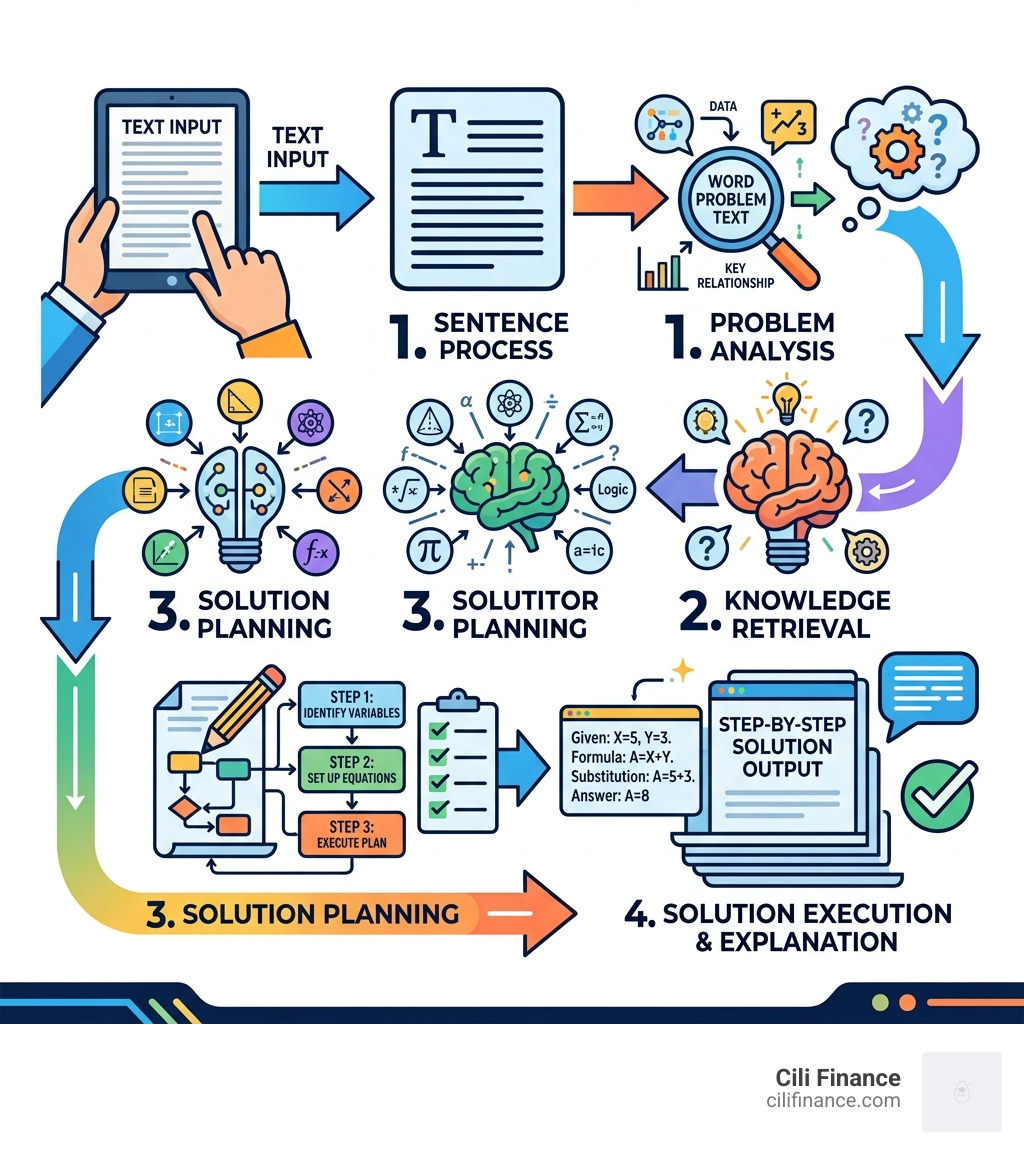
The Evolution of Math Word Problems AI in 2026

As of April 2026, the landscape of educational technology has shifted dramatically. We’ve moved past the era where AI simply guessed the next word in a sentence. Today’s math word problems ai engines are sophisticated “reasoning machines.”
In the early days of AI, large language models struggled with multi-step reasoning. They might get the first part of a “train leaving the station” problem right but trip up on the final calculation. Research into the GSM8K dataset—a benchmark of 8,500 high-quality grade school math word problems—showed that early models were only about half as accurate as a focused student.
However, the breakthrough came with “verification methods.” Instead of just generating one answer, modern AI systems now generate multiple candidate solutions and use a specialized “verifier” to pick the best one. This verification process provides a performance boost equivalent to a 30x increase in model size. For example, industry research found that a 6B parameter model with a verifier could outperform a massive 175B parameter model that was just “guessing.”
Today, modern neural engines use symbolic AI. This means the AI doesn’t just predict the answer; it follows strict mathematical rules and axioms. It treats math like a logical puzzle rather than a language pattern. This evolution allows modern tools to achieve over 99% accuracy in recognizing variables and linguistic context, making them indispensable for students tackling everything from basic arithmetic to university-level physics.
Essential Features of Modern AI Math Solvers
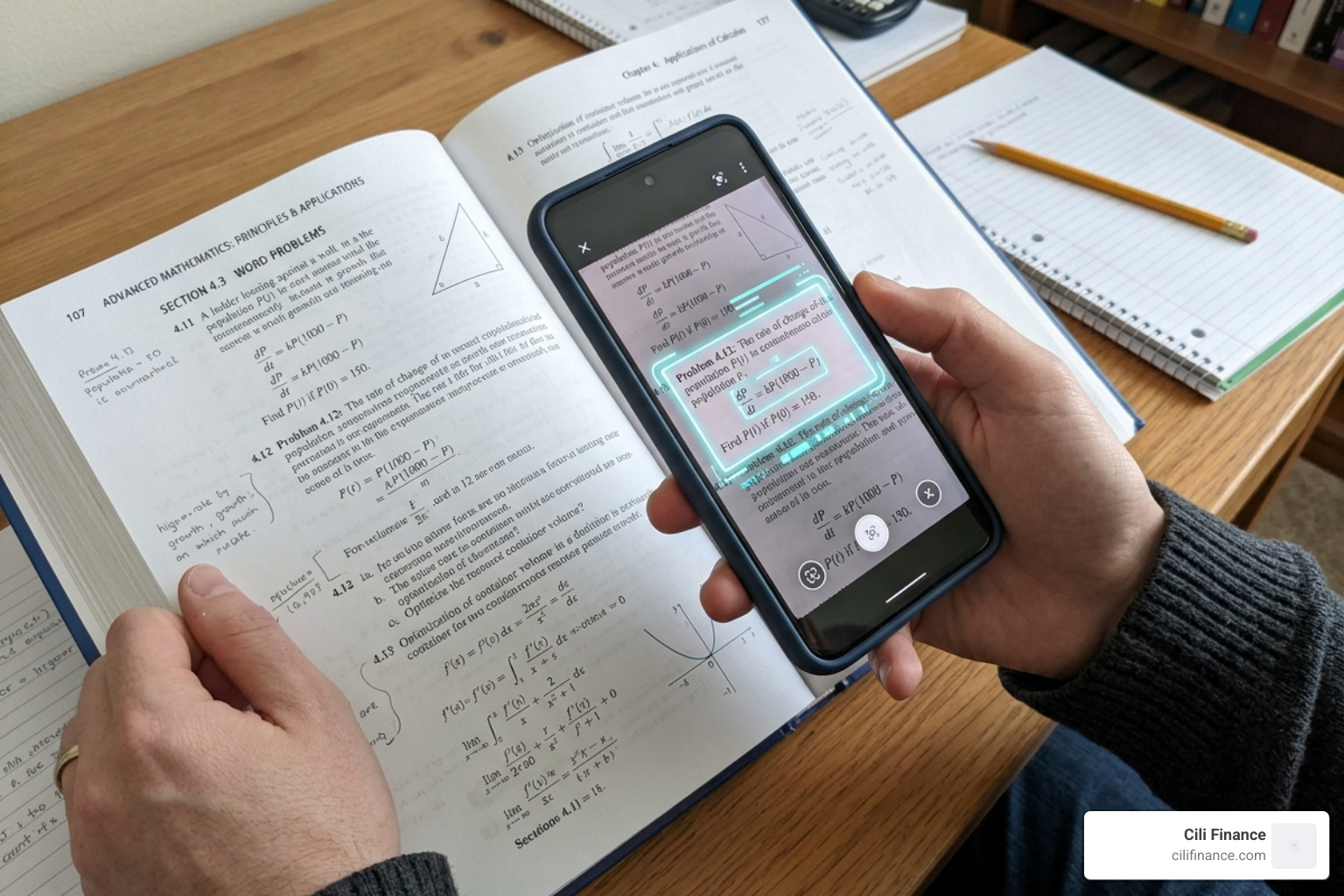
When we look at the best tools in 2026, they all share a few “must-have” features that make them superior to a standard search engine or a basic calculator.
Multimodal Inputs and OCR
The days of typing out long, annoying equations are over. Modern math word problems ai tools utilize advanced Optical Character Recognition (OCR).
- Photo Scanning: You can snap a picture of a printed textbook or a messy handwritten notebook. Top-tier educational AI tools boast a 99% accuracy rate for recognizing handwriting.
- Voice Input: If you’re on the go, you can simply read the problem aloud.
- PDF Integration: For college students, advanced solvers allow you to upload an entire 50-page problem set. You can circle a specific question on your screen, and the AI provides an instant breakdown.
Advanced Formatting and Visualization
It’s not just about the final number; it’s about seeing the work.
- LaTeX Support: Solutions are presented in beautiful, academic-grade formatting, making them easy to read and understand.
- 3D Visualization: For geometry and multivariable calculus, these tools can generate interactive 3D graphs. You can rotate a shape or examine the slope of a surface in real-time.
- Integrated Video Tutorials: Some platforms even generate custom AI-voiced video animations that explain the specific diagram in your problem.
Advanced Reasoning in Math Word Problems AI
The core of these tools is “Chain-of-Thought” processing. When you input a word problem about “ratios” or “work rates,” the AI doesn’t just jump to the answer. It identifies the “knowns,” defines the “unknowns” (like “let x be Sarah’s age”), and builds the equation step-by-step.
This robust symbolic computation ensures that the AI doesn’t “hallucinate” (make things up). Because it uses a logic engine rather than just a language model, it can handle university-level calculus and complex physics word problems with the same precision it uses for 5th-grade fractions.
Customizable Problem Generation for Educators
AI isn’t just for solving; it’s for creating. Teachers are now using AI-powered generators to build engaging, story-driven math tasks.
- Differentiation: A teacher can take one concept—like “addition with regrouping”—and ask the AI to generate four different versions: one themed around a lemonade stand, one about a space mission, and two others at different difficulty levels for students who need more or less challenge.
- Common Core Alignment: These generators can automatically align problems with specific educational standards, ensuring that classroom practice matches state requirements.
Comparing AI Solvers to Traditional Mathematical Tools
Why use a specialized math word problems ai instead of just Googling the answer or using a high-end TI-84 calculator? We’ve broken down the differences below:
| Feature | AI Word Problem Solver | Standard Calculator | General AI Chatbot |
|---|---|---|---|
| Handles Text | Yes, parses context | No | Yes, but prone to errors |
| Speed | Under 10 seconds | Instant (if formula known) | 15-30 seconds |
| Step-by-Step | Detailed pedagogical logic | Usually none | Varies (can be “wordy”) |
| Accuracy | 98.7% – 99.5% | 100% (arithmetic only) | 70% – 85% |
| Learning Aid | Acts as a 24/7 tutor | Just a tool | General assistant |
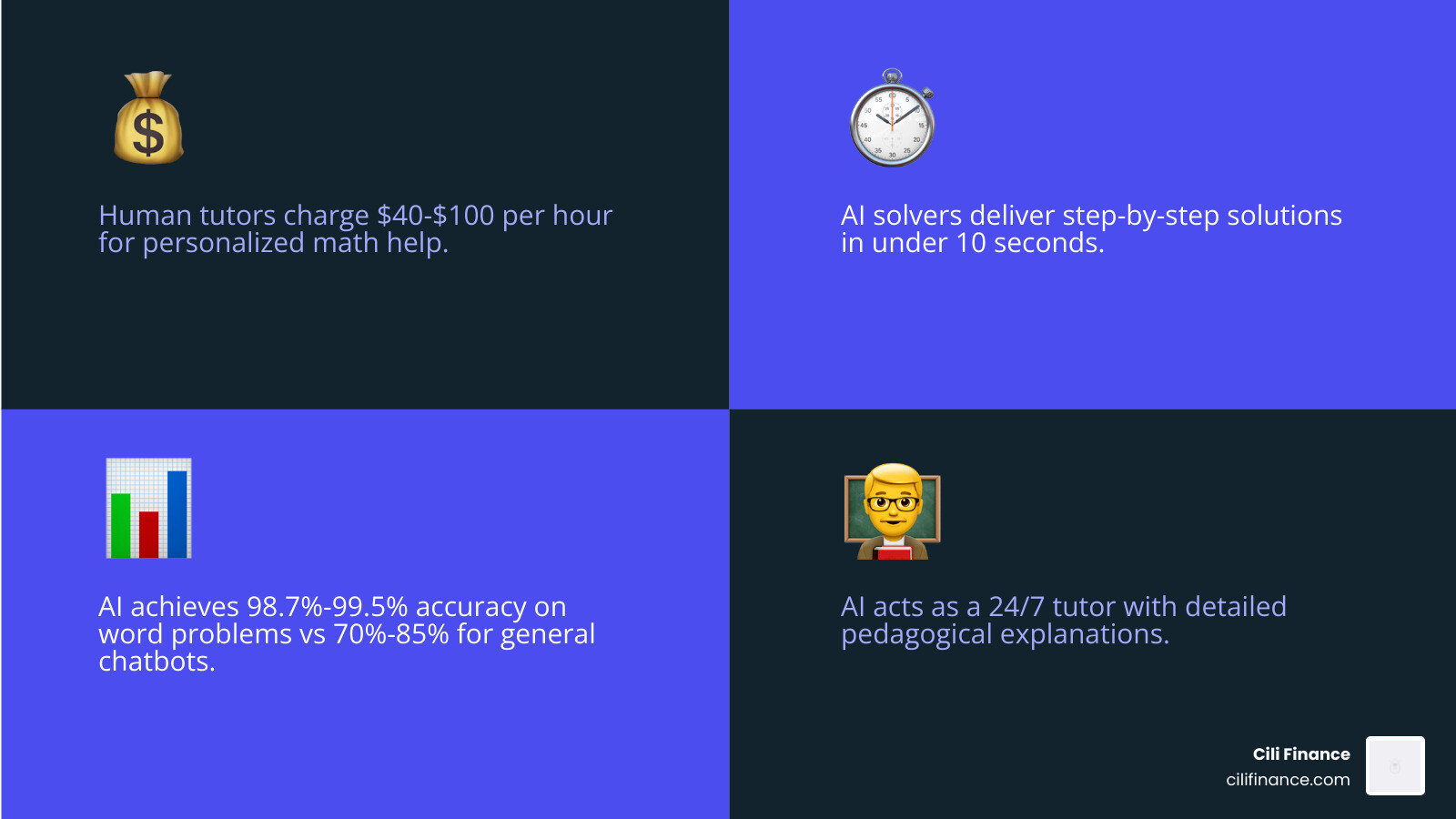
As the infographic shows, a human tutor can cost anywhere from $40 to $100 per hour. Meanwhile, an AI solver provides similar “whiteboard-style” explanations for a fraction of the cost—or even for free. Furthermore, searching for a specific word problem on Google often takes 15 to 30 minutes of scrolling through forums to find a similar (but not identical) example. A specialized math word problem solver gives you the exact answer to your specific numbers in under 10 seconds.
Maximizing Accuracy with Math Word Problems AI
One of the biggest concerns with AI is accuracy. In 2026, the best tools have largely solved this through “Symbolic Verification.”
- Leading solvers claim 20% higher accuracy than standard general-purpose models.
- Advanced systems boast a 99.5% accuracy rate across all disciplines.
- Specialized test-prep tools maintain a 98.7% accuracy rate on standardized test problems (like the SAT and ACT).
These tools use isolated containers for processing, ensuring that your data is handled with “zero-log” privacy. This means your homework photos aren’t stored on a server forever; they are processed and then deleted, protecting student privacy.
Best Practices and Frequently Asked Questions
To get the most out of these tools, we recommend a few best practices:
- Don’t Paraphrase: When using a text-based solver, paste the entire problem. The AI needs the linguistic context to identify which operation to use.
- Check the Units: Ensure your problem doesn’t mix units (like miles and kilometers) unless that’s part of the challenge.
- Use it to “Unblock”: Instead of just copying the answer, look at the first two steps. Try to finish the rest yourself, then use the AI to verify your final result. This builds “math intuition” over time.
Are AI math word problem solvers free to use?
Most of the top tools operate on a “freemium” model.
- Free Versions: Usually allow you to see the final answer and perhaps the first one or two steps of the solution. This is great for quick checks.
- Premium Subscriptions: These typically unlock “Expert Mode,” which provides full academic-level breakdowns, 3D graphing, and ad-free experiences.
- Free Trials: Many platforms offer a free trial period so you can test the “Pro” features before committing.
What difficulty levels can math word problems ai handle?
They are incredibly versatile. We have seen these tools successfully solve:
- K-12 Arithmetic: Fractions, decimals, and basic “story” problems.
- High School Algebra & Geometry: Systems of equations, area/volume, and trigonometry.
- University Level: Multivariable calculus, linear algebra, differential equations, and complex statistics (like hypothesis testing).
- Professional Sciences: Physics (kinematics, Newton’s laws), Chemistry (stoichiometry), and even Financial Math (interest rates, ROI).
How do these tools handle handwritten or photo inputs?
As mentioned earlier, OCR technology has become frighteningly good. As long as your photo is well-lit and the text is legible to a human, the AI can usually read it. If you’re using a modern AI solver, just hit the “Scan” button, and the AI will convert your handwriting into a digital equation in seconds.
Conclusion
The rise of math word problems ai is one of the most exciting developments in 2026. These tools aren’t just “cheating machines”—they are personalized tutors that are available 24/7. They bridge the gap between confusing word descriptions and clear mathematical logic, helping students move from frustration to mastery.
By providing step-by-step pedagogical explanations, these AI solvers help students understand the why behind the math, not just the what. Whether you are a student trying to pass a tough calculus exam, a parent helping with 8th-grade algebra, or an educator looking to create more engaging lessons, there has never been a better time to embrace AI in the classroom.
For those looking to apply these mathematical concepts to real-world scenarios—like managing personal budgets or understanding investment growth—mastering the logic behind the numbers is the first step. Learn more about how financial math services can help you manage your future.
The future of STEM education is here, and it’s powered by intelligent, reasoning-based AI that makes learning accessible for everyone.
